Everyone talks about Monaco. Fewer people talk about the small peninsula just next door, which has an older castle, quieter coves, better restaurants, and no lines. Roquebrune-Cap-Martin is the sort of place that has always known its own worth. It has kept its shape while the rest of the Riviera has changed around it. Here is a guide, from someone who has spent a great deal of time here, to what actually makes this stretch of coast extraordinary.
Where you actually are
Roquebrune-Cap-Martin sits between Monaco and Menton, on the sunniest stretch of the French Riviera. It is small enough that you can walk from the medieval village at the top of the hill down to the Mediterranean in twenty-five minutes, and quiet enough that the walk still passes fig trees and the sound of someone playing petanque in a courtyard.
The commune has two very different halves. Uphill, the medieval village of Roquebrune wraps around a tenth-century castle, said to be the oldest feudal castle still standing in France. Downhill, the Cap-Martin peninsula juts into the sea between the coast and Monaco, its pine-covered headland dotted with villas that Cocteau, Chanel, Le Corbusier, and Empress Eugénie all once lived in. It is quite something to walk a coastal path that so much of the twentieth century's art passed along.
The medieval village at the top of the hill
Start with the château. The tenth-century tower is climbable, and from the top the view stretches from the Italian coast east of Ventimiglia all the way to the western headlands beyond Nice. Below, the village is a maze of vaulted passageways and stone staircases that have barely changed since it was built. The place feels almost stubborn in its refusal to be gentrified. You will still see laundry on the lines above the streets.
Eat lunch at Au Grand Inquisiteur, tucked into a barrel-vaulted room that used to be a cellar. The menu leans into the food that people in this village actually cook: stockfish à la niçoise, small stuffed vegetables, sardines with pissaladière. Reservations are essential in summer. At the end of the meal, walk the perimeter of the village to see what remains of the ramparts, and then descend along the Rue Moncollet, one of the strangest and prettiest medieval streets on the coast, tunnelled through the rock in places.
Le Corbusier's Cabanon
Halfway down the peninsula, next to a small train station, sits a tiny wooden hut just under fifteen square metres in size. It is the summer house that Le Corbusier built for himself, a self-imposed constraint on a career of large projects. He designed every fitting inside it, drew murals on the walls, and swam every day in the small cove below until he drowned there in 1965. The Cabanon is a UNESCO site and can be visited by guided tour through the Roquebrune tourist office. Even for people who do not care about modernist architecture, the tour is quietly extraordinary. You come away thinking about what a person actually needs.
Book at least a week ahead. The tours run from Tuesday to Saturday and are almost always full in season.
The Sentier du Littoral
This is the coastal path that curves along the base of the Cap-Martin peninsula from the town beach of Roquebrune to the border with Monaco. It runs for about seven kilometres, mostly hugging the shoreline, sometimes tunneled beneath cliffs, sometimes threading between garden walls and the sea. It is the finest coastal walk anywhere between Nice and the Italian border. Do it at golden hour, in either direction, and be prepared to stop often.
You will pass the Villa Cypris, once owned by the Guinness family. You will pass the ruined Roman monument known as the Trophée d'Auguste (technically slightly inland, but visible above). You will pass the small cove where Eileen Gray built the villa E-1027, a piece of architecture Le Corbusier so admired that he cheekily painted a series of murals on its walls without permission, then built his Cabanon next door. And you will end up in Monaco, in the shadow of the Fairmont Hotel and the port, with a view of the palace across the harbour and the taste of the sea still in your hair.
The Cap-Martin peninsula itself
The tip of the peninsula is the highest-density concentration of private villas along the entire coast, and it has been that way since the 1880s. Empress Eugénie built her retreat here. Chanel spent summers here. There are still working funiculars descending from a few properties to the water below. Walking through the peninsula is like walking through the entire aesthetic history of the Riviera: Belle Époque villas with towers and painted facades, austere modernist boxes, a scattering of 1970s follies, and the occasional new build that tries hard not to draw attention. Most of the villas are quiet behind their gates. That is part of the point.
The public beaches on the peninsula are small and pebbled: Plage du Buse near the train station is the easiest to reach; Plage du Golfe Bleu, further west, is where the local families go. Both are perfectly good for a swim. For a proper day at a private beach club, the Monte-Carlo Beach at the base of the Monte-Carlo Country Club has been the setting for a century of Riviera photographs and does an excellent lunch. In the other direction, Menton has quieter beaches, better ice cream, and cheaper parking.
Where to eat
Mirazur in Menton, twenty minutes east, is the closest three-star restaurant to Roquebrune and one of the greatest restaurants in the world. Mauro Colagreco's tasting menu is drawn almost entirely from his own gardens, and the room itself, with its wall of windows above the Italian border, is beautiful. Book three months in advance for dinner; lunch reservations sometimes come available in the last week.
Le Louis XV, Alain Ducasse's restaurant inside the Hôtel de Paris in Monaco, is the more formal alternative. La Chèvre d'Or in Èze, on a terrace four hundred metres above the sea, is unforgettable at sunset. Château Eza a hundred metres further along is quieter and equally magical.
For something simpler: Le Grand Bleu, on the port of Menton, does a beautiful bouillabaisse. Bacio, in the old town of Menton, is the local pizzeria that Monégasques drive over the border for. And on the way back toward Roquebrune, Le Barbagiuan, a tiny place tucked into a side street, is the most authentic Monégasque food you can eat outside the palace.
Practical notes
Getting here is easy. Nice Côte d'Azur Airport is thirty-one kilometres away, about forty-five minutes by car in normal traffic. The TER train that runs along the coast from Ventimiglia to Cannes stops at Roquebrune-Cap-Martin station, at the base of the peninsula, and again at Cap-Martin-Roquebrune slightly further along. Trains are frequent, cheap, and scenic; on days when you do not need a car it is often faster to take the train than to drive, particularly into Monaco.
Book everything a season ahead in July and August. The peninsula is small, restaurants fill early, and the best beach clubs run at capacity. May, June, September, and October are dramatically better times to visit, less busy, still warm enough to swim, and the light is softer. Winter here is genuinely mild and often sunny; the Riviera was originally built as a winter destination for northern Europeans, and it still rewards visitors then.
Where to stay
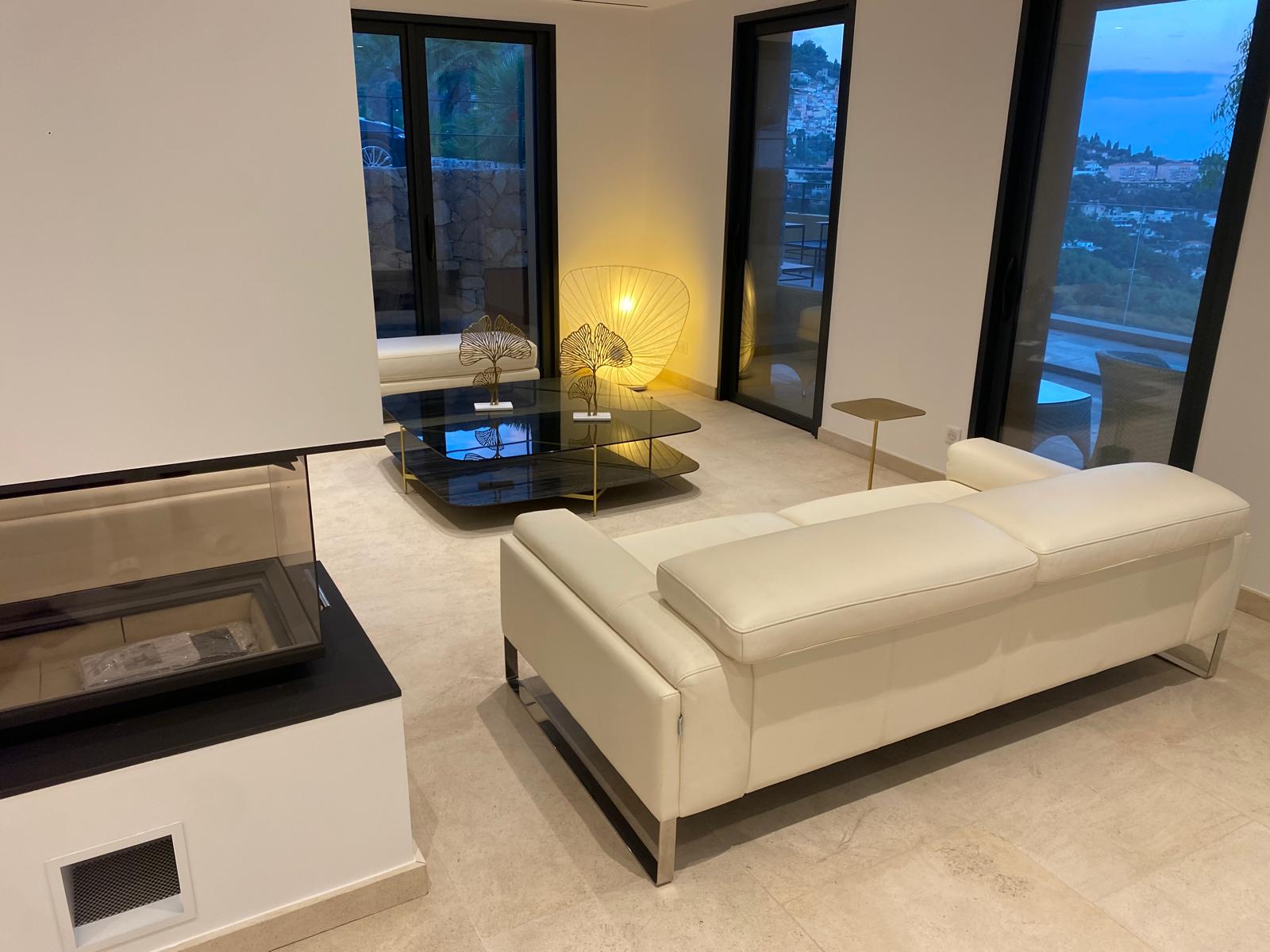
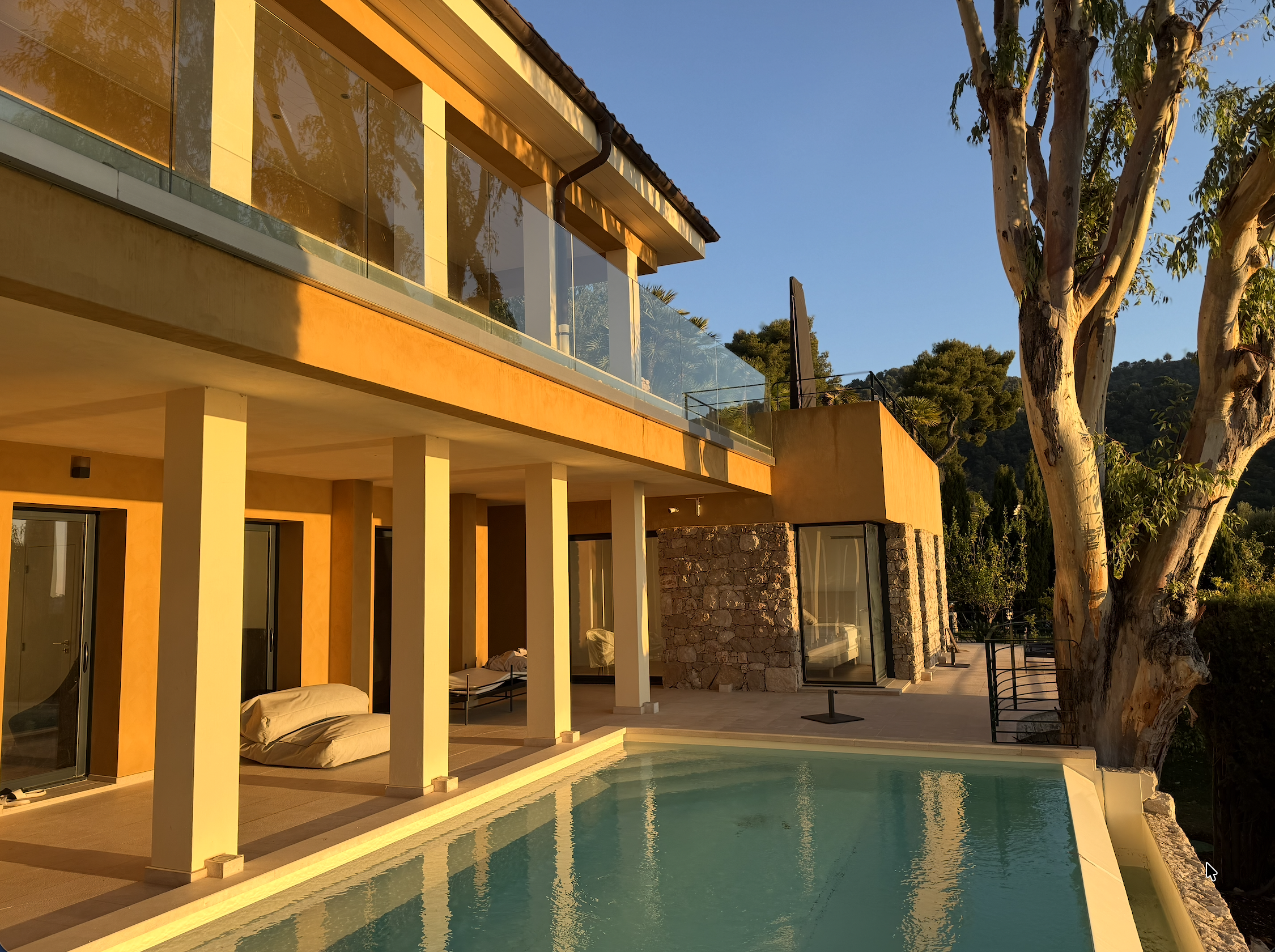
Villa Carlina is our residence above Roquebrune-Cap-Martin, six bedrooms and a private infinity pool with a panoramic view of the Mediterranean from Monaco to the Italian border. Four kilometres from the medieval village, fifteen from Menton, an easy drive to Nice, and walking distance from both the coastal path and the train station. The residence takes reservations year-round, with a six-night minimum stay. If any of what is on this page appeals to you, we would love to be your base while you find your own way to know this coast.